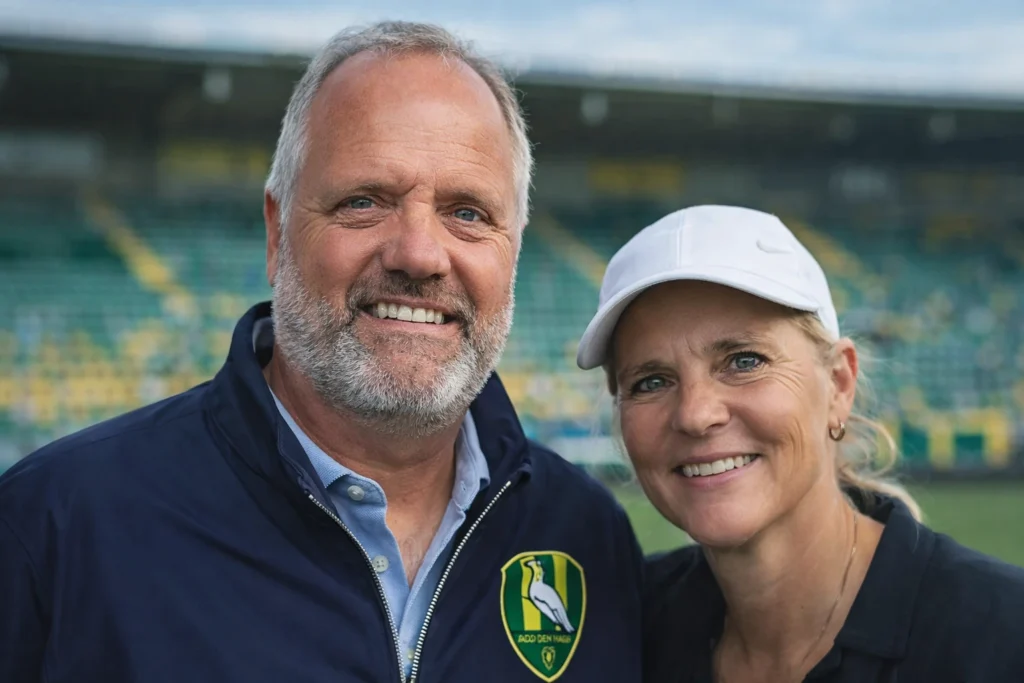

For many people encountering the name Marten Glotzbach for the first time, the search begins with someone else. He is often introduced as the husband of Sarina Wiegman, the highly respected manager of England’s women’s national football team. But that connection, while real and important, only tells part of the story. Glotzbach has spent decades in Dutch football, building a career that has largely unfolded away from global headlines but not without purpose or persistence.
His path has never been about sudden fame or dramatic leaps. Instead, it reflects the rhythms of local football culture in the Netherlands, where coaching is often rooted in community clubs, youth development, and steady progression. By the time his name began circulating more widely, he had already spent years shaping players and teams in ways that don’t always make international news.
That contrast—between quiet professional work and growing public curiosity—is what makes his story worth telling in full.
Early Life and Family
Marten Glotzbach was born in the Netherlands, with strong ties to The Hague, a city known for its deep football culture and long-standing amateur clubs. While there is limited publicly available detail about his early childhood, the outline is familiar for many Dutch football figures. He grew up in an environment where the sport was woven into daily life, not as spectacle but as routine.
Football in the Netherlands often begins at the neighborhood level, with children joining local clubs early and staying connected to them for years. That system tends to produce not only players but also coaches who understand the game from the ground up. Glotzbach’s later career suggests he followed that path, absorbing the sport through participation, observation, and eventually instruction.
Not many people know this, but in Dutch football culture, the line between player and coach can blur over time. Many coaches begin without grand ambitions of leading top-tier teams, instead developing a sense of responsibility toward their club communities. That ethos appears to have shaped Glotzbach’s approach from the beginning.
Education and Early Coaching Interests
Unlike some high-profile managers who emerge through elite playing careers, Glotzbach’s trajectory seems to have been built more through coaching education and hands-on experience. The Netherlands has a well-structured coaching certification system, and those who stay in the game often commit to formal training alongside practical work.
What’s clear is that by the time he began taking on more structured roles, he had already embraced coaching as a long-term pursuit rather than a temporary extension of playing. That choice matters. Coaching in the Dutch system requires patience, especially at lower levels where resources are limited and success is measured in development rather than trophies.
There is no widely documented single breakthrough moment in his early years. Instead, his progress appears to have been gradual, moving through local clubs and youth teams, gaining trust and responsibility over time. That slow build would later define much of his career.
Building a Career in Dutch Football
Glotzbach’s professional life has been closely tied to clubs in and around The Hague. He worked with organizations such as HBS Craeyenhout, a historic amateur club, as well as teams like Westlandia and SVV Scheveningen. These are not globally recognized names, but within Dutch football they represent important stepping stones where coaches learn to manage squads, handle pressure, and build systems.
Here’s where it gets interesting. Coaching at this level demands versatility. A coach might be responsible not only for tactics but also for player development, team culture, and even logistical coordination. It’s a role that requires adaptability and resilience, especially when working with players balancing football with jobs or studies.
Over time, Glotzbach also became involved with youth development at ADO Den Haag, one of the Netherlands’ established clubs. His work with youth teams, including girls’ squads, reflects a broader shift in Dutch football toward investing in women’s and youth programs. This experience would later prove significant when he moved into a senior role.
By the late 2010s and early 2020s, he had established himself as a coach with a solid reputation in regional football circles. He was not a headline name, but he was known within the networks that matter—clubs, players, and fellow coaches who value consistency and reliability.
The ADO Den Haag Women Appointment
In December 2024, Marten Glotzbach stepped into one of the most visible roles of his career when he was appointed head coach of ADO Den Haag Women. The appointment marked a shift from youth and assistant roles into a senior position in the Dutch women’s Eredivisie.
At the time, he was in his mid-50s and already familiar with the club’s structure, having worked within its youth system. That internal knowledge likely played a role in his selection. Clubs often look for coaches who understand their philosophy and can maintain continuity, especially in women’s football, where long-term development is a key priority.
But the role also brought a new level of attention. His connection to Sarina Wiegman added an extra layer of public interest, particularly outside the Netherlands. For some observers, it raised questions about expectations and scrutiny. For Glotzbach, it meant navigating a position where his work would be viewed through both a professional and personal lens.
That said, the job itself remained grounded in familiar challenges: building a competitive team, managing players, and delivering results in a demanding league.
A Short but Defining Chapter
Glotzbach’s tenure at ADO Den Haag Women lasted less than a year, ending in November 2025. The club announced his departure before the completion of his contract, which had originally been set to run until mid-2026.
Coaching careers are often shaped by such moments. Results, team dynamics, and strategic direction all play a role in whether a coach remains in position. While detailed public explanations for his departure were limited, the decision reflects the realities of professional football, where stability can be difficult to maintain.
The truth is, even experienced coaches face abrupt endings. A single season can define how a tenure is remembered, regardless of the work that preceded it. For Glotzbach, the ADO Den Haag chapter stands as both a peak in visibility and a reminder of the pressures that come with stepping into a higher-profile role.
What’s surprising is how quickly public attention can rise and fall. His name became more widely searched during this period, only to recede again once the role ended.
Marriage to Sarina Wiegman
Much of the global curiosity about Marten Glotzbach stems from his marriage to Sarina Wiegman, one of the most successful coaches in women’s football. Wiegman has led teams to major international titles and is widely regarded as a defining figure in the modern game.
Their relationship, however, has remained largely private. They have avoided turning their personal life into a public narrative, even as Wiegman’s profile has grown significantly. That restraint has shaped how Glotzbach is perceived. He is present in the background of a high-profile career but does not seek attention for it.
But here’s the thing. In sports culture, especially at the highest levels, the lives of coaches and their families often intersect with public interest whether they intend to or not. As Wiegman’s success with England continued, more people began searching for details about her personal life, leading them to Glotzbach.
Rather than leaning into that visibility, he has maintained a low-key presence, focusing on his own work within Dutch football.
Family Life and Football Connections
Glotzbach and Wiegman have children, and football appears to run through the family. Their daughter, Lauren Glotzbach, has been associated with ADO Den Haag’s women’s setup, creating a unique dynamic during his time as head coach.
Situations like this are not uncommon in football, particularly in smaller leagues where family connections and club structures overlap. Still, they require careful management to maintain professionalism and fairness within the team.
There is little public commentary from Glotzbach about this aspect of his life, which aligns with his overall approach. He has kept personal matters largely out of the spotlight, allowing his work to speak for itself.
Life After ADO Den Haag
Since leaving ADO Den Haag Women in late 2025, Glotzbach has returned to a quieter phase of his career. There has been no widely reported major appointment following his departure, which suggests he may be taking time to reassess his next steps or continuing work at a less visible level.
That kind of transition is common in coaching. Careers rarely follow a straight upward line, and periods between roles can be just as important as the positions themselves. Coaches often use that time to reflect, study the game, and prepare for future opportunities.
Given his background, it would not be surprising to see him re-engage with youth development or regional clubs, areas where his experience is well suited.
Public Interest and Online Searches
The rise in searches for “Marten Glotzbach” reflects a broader pattern in how people engage with public figures. When someone like Sarina Wiegman achieves international recognition, interest naturally extends to those close to her.
But search results don’t always offer clarity. Many online profiles repeat the same limited information, sometimes without clear sourcing. That can create a distorted picture, where speculation fills gaps that haven’t been properly reported.
A careful look at Glotzbach’s career shows a different reality. He is not a celebrity in the traditional sense, nor is he defined solely by his relationship. He is a working coach whose career has unfolded within the structures of Dutch football, with moments of visibility tied to specific roles.
Frequently Asked Questions
Who is Marten Glotzbach?
Marten Glotzbach is a Dutch football coach known for his work with various clubs in the Netherlands and for his role as head coach of ADO Den Haag Women in 2024 and 2025. He has spent much of his career in regional football, focusing on youth development and local teams. His name has also gained wider recognition through his marriage to England manager Sarina Wiegman. Despite increased public interest, he has maintained a relatively low profile.
Is Marten Glotzbach married to Sarina Wiegman?
Yes, Marten Glotzbach is married to Sarina Wiegman. Wiegman is one of the most successful coaches in women’s football and has led national teams to major international titles. The couple has kept their relationship largely private, even as Wiegman’s career has brought significant public attention. Their partnership is often mentioned in media coverage, but they rarely speak publicly about their personal life.
What teams has Marten Glotzbach coached?
Glotzbach has worked with several Dutch clubs over the years, including HBS Craeyenhout, Westlandia, and SVV Scheveningen. He has also been involved in youth coaching at ADO Den Haag before becoming head coach of the women’s team. His career reflects a strong connection to local and regional football rather than high-profile international roles. Much of his work has focused on development and team building.
Why did Marten Glotzbach leave ADO Den Haag Women?
Marten Glotzbach left his position as head coach of ADO Den Haag Women in November 2025 before the end of his contract. The club announced the decision but did not provide extensive public details about the reasons behind it. In football, coaching changes can be influenced by results, team performance, or strategic direction. His departure fits within the broader pattern of short tenures that are common in the sport.
Does Marten Glotzbach have children?
Yes, Marten Glotzbach and Sarina Wiegman have children. Their daughter, Lauren Glotzbach, has been associated with ADO Den Haag’s women’s football setup. The family’s connection to the sport highlights how football can span generations, especially in countries like the Netherlands where club culture is deeply rooted. Despite this, the family has kept most personal details out of the public eye.
READ ALSO: Mike Rattler: The Private Figure Behind a Rising Football Legacy
Conclusion
Marten Glotzbach’s story is not one of sudden fame or headline-grabbing achievements. It is a story shaped by years of work within the fabric of Dutch football, where progress is often measured in steady contributions rather than dramatic breakthroughs. His career reflects the kind of commitment that keeps the sport functioning at every level, from youth teams to senior squads.
That said, public interest in his life has grown in ways that don’t always align with the scale of his career. His connection to Sarina Wiegman has brought attention, but it has also risked overshadowing the work he has done independently. The challenge for any profile like this is to hold both truths at once.
What emerges is a portrait of a coach who has navigated football’s demands with persistence and restraint. He has taken opportunities as they came, stepped into more visible roles when they arose, and handled the pressures that followed.
Looking ahead, his next chapter remains open. Whether he returns to a high-profile position or continues working within the quieter corners of the game, his career offers a reminder that not every football story is defined by fame. Some are built over time, in places where the spotlight rarely reaches, but where the work still matters.